Every summer, homeowners across Mesa, Gilbert, Chandler, Queen Creek, Tempe, and Scottsdale face the same unsettling problem. A Mesquite tree that looked healthy in the spring suddenly loses a major limb, splits at the trunk, or comes down during a monsoon storm. The damage can affect fences, roofs, vehicles, irrigation systems, and even neighboring properties. While Arizona’s summer storms are powerful, most Mesquite problems do not begin during the storm itself. They usually develop slowly over time through structural weakness, improper pruning, shallow roots, and years of stress that go unnoticed until high winds expose the issue.
Mesquite trees remain one of the most common shade trees throughout the East Valley because they are well adapted to the Sonoran Desert. Homeowners in Mesa, Gilbert, Chandler, and Queen Creek value them for their drought tolerance, broad canopy, and ability to provide relief from Arizona’s intense heat. When properly maintained, a Mesquite can thrive for decades. However, when these trees are left without structural care, they can become surprisingly vulnerable once monsoon season arrives.
How Mesquite Growth Habits Create Structural Weaknesses
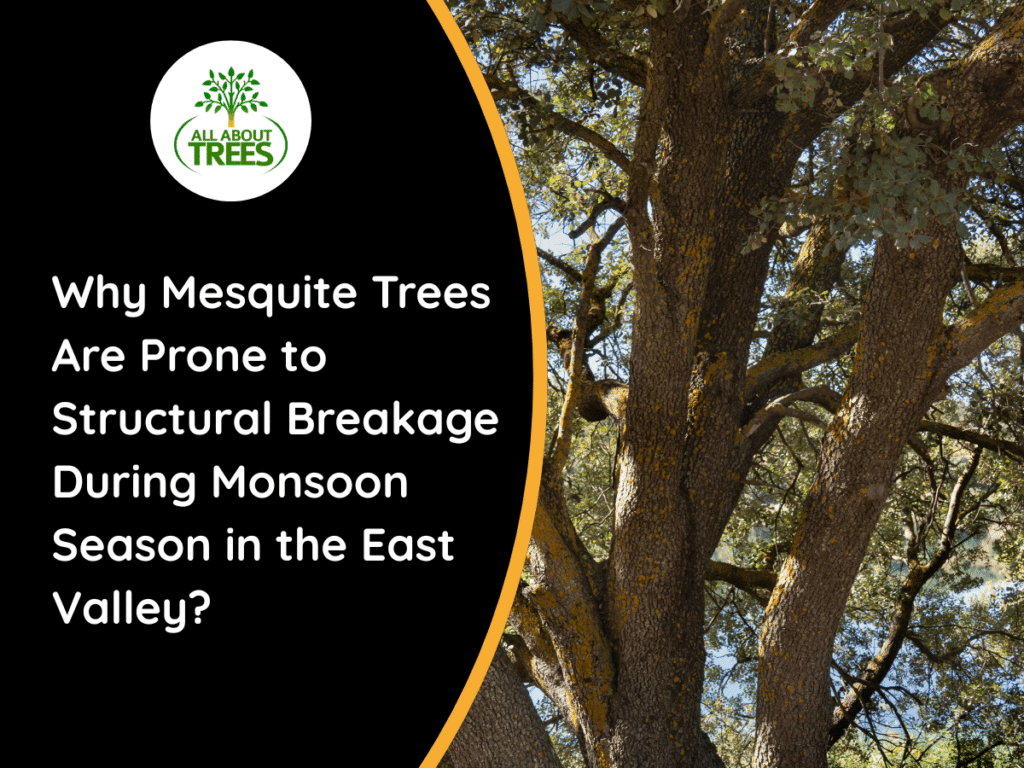
One of the main reasons Mesquite tree damage during monsoon season occurs is due to the way they naturally grow. Mesquites tend to develop wide, spreading canopies with long lateral limbs. This growth habit creates excellent shade, but it also places significant weight on branch attachments and trunk unions. If the canopy becomes too dense or if limbs are allowed to extend too far without support, the tree begins to carry more stress than it should.
In calm weather, these weaknesses often remain hidden. A homeowner may see a full, attractive canopy and assume the tree is sound. In reality, the structure may already be compromised. When strong winds arrive during monsoon season, the tree is forced to absorb sudden pressure from multiple directions. A Mesquite with poor structure can behave like a sail, catching wind and transferring force through weak branch unions and overloaded limbs. That is when large branches begin to split or the entire tree becomes unstable.
This issue is especially common in older East Valley neighborhoods where mature Mesquites have been growing for decades. Trees that were once small landscape additions have now become large shade trees extending over driveways, sidewalks, roofs, and neighboring yards. As they mature, they require more careful structural management than many homeowners realize.
Irrigation, Soil Conditions, and Root Stability
Another major factor in Mesquite tree instability is root development. Mesquites are desert-adapted trees that perform best when they are encouraged to grow deep, stable root systems. Unfortunately, many properties in Mesa, Gilbert, and Chandler receive irrigation designed primarily for turfgrass rather than desert trees. Frequent shallow watering can cause roots to remain close to the soil surface instead of growing deeper into the ground.
A shallow root system may not be obvious from above, but it can create serious problems during high winds. Trees with shallow roots are less anchored and more likely to shift, lean, or come down when storms bring sudden gusts. This becomes even more concerning in neighborhoods where Mesquites have been watered heavily for years alongside lawns, shrubs, and other landscape plants.
Soil conditions can also influence stability. Compacted soil, poor drainage, and inconsistent watering patterns can all affect how well a tree establishes itself. In some cases, a Mesquite may appear healthy because it has a full canopy and green foliage, but the root system beneath the surface may not be strong enough to support the tree during a severe monsoon event. That is why visible health alone is not a reliable indicator of storm readiness.
Why Improper Pruning Makes the Problem Worse
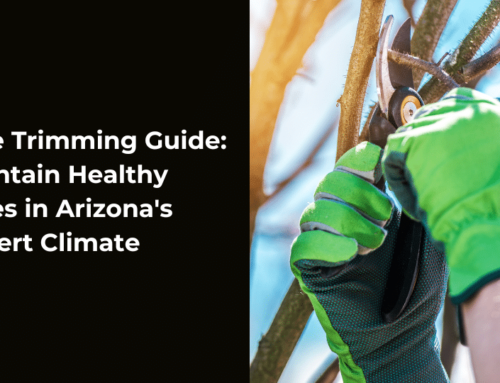
Improper pruning is another common reason Mesquite trees experience structural breakage during monsoon season. Many homeowners hire low-cost trimming services that focus on removing as much growth as possible in a short amount of time. These crews may thin the canopy too aggressively, remove too much interior structure, or make cuts that do not support the tree’s long-term health. While this may seem like a good way to reduce storm risk, it often has the opposite effect.
When a Mesquite is over-thinned, it responds by producing rapid regrowth. That regrowth often consists of long, weakly attached branches that are more likely to break in future storms. Poor pruning can also leave behind wounds that weaken branch unions and create points of structural weakness over time. Instead of improving the tree’s architecture, improper trimming can make it more vulnerable.
Professional pruning takes a different approach. The goal is not to make the tree as small as possible. The goal is to improve balance, reduce unnecessary weight, and preserve strong branch attachments while maintaining the tree’s natural form. For Mesquite trees in Mesa, Gilbert, Chandler, and surrounding East Valley communities, structural pruning is one of the most effective ways to reduce storm damage before monsoon season begins.
Mature Neighborhood Trees Need Ongoing Structural Care
The age of many East Valley neighborhoods also plays a major role in Mesquite problems. Communities built during the 1990s and early 2000s now contain mature trees that have grown far larger than the original landscape plans may have anticipated. A Mesquite that once fit neatly into a front yard may now stretch over a roofline or extend into a neighboring property. As these trees mature, the need for regular inspection and maintenance becomes much more important.
Large trees are not automatically dangerous, but they do require more attention. Over time, deadwood can accumulate, branch unions can weaken, and canopy imbalances can develop. These issues are not always visible to the average homeowner, especially when the tree has a dense canopy. A tree may look healthy from the street while still carrying hidden structural defects that become obvious only when a storm arrives.
This is why proactive tree care matters so much in Mesa, Gilbert, Chandler, Queen Creek, Tempe, and Scottsdale. Waiting until a branch breaks or a tree begins to lean often means the problem has already progressed too far. Regular inspections can identify concerns early, giving homeowners the chance to address them before they turn into expensive emergencies.
How to Reduce Mesquite Tree Damage During Monsoon Season?
The good news is that preventative care can be reduce Mesquite tree issues. Proper pruning, routine inspections, and species-specific maintenance all help improve a tree’s ability to withstand Arizona’s summer storms. A well-maintained Mesquite is better able to distribute weight, resist wind pressure, and recover from seasonal stress.
Homeowners should think about tree care as part of monsoon preparation. Just like checking gutters, securing outdoor furniture, and inspecting the roof. Trees are often the largest living feature on a property. These trees can also become one of the most costly sources of damage when neglected. A mature Mesquite that has not been evaluated in years may already have weak limbs. Additionally, poor structure, or root issues increase the risk of structural breakage.
Professional tree care is especially valuable because it takes the tree’s species, age, location, and condition into account. A Mesquite growing near a home in Chandler may need different pruning than one in a wide-open yard in Queen Creek. Trees in older Mesa neighborhoods may require more structural attention than younger landscape trees in newer developments. Understanding those differences is essential for reducing storm-related damage.
Protecting East Valley Properties with Professional Tree Care
For homeowners throughout Mesa, Gilbert, Chandler, Queen Creek, Scottsdale, and Tempe, preparing for monsoon season should include more than just storm cleanup after the fact. The best time to address Mesquite tree concerns is before the strongest winds arrive. By identifying structural weaknesses early and correcting them with proper pruning, homeowners can protect their homes, vehicles, landscapes, and neighboring properties from avoidable damage.
At All About Trees, we regularly help East Valley homeowners evaluate mature Mesquite trees before monsoon season begins. A professional assessment can reveal hidden risks, recommend the right pruning approach, and provide peace of mind before Arizona’s summer storms arrive. While no tree is completely storm-proof, proper maintenance can dramatically improve a Mesquite’s ability to withstand the challenging conditions that make Arizona summers so unpredictable.